


 407-450-2020
I need to retrieve the previous step outputs to get the specific business details, internet search data, and other information needed to write the blog post.
I have the article details but I need to retrieve the internet search data to incorporate current trends and supporting facts. Let me search for relevant information about medical office painting services and industry trends.
Let me scrape one of the existing Overtop articles to understand their approach, and also search for more specific healthcare and medical office statistics.
Perfect! I now have all the information I need. I have the Overtop company profile, their focus on medical office painting, and the article details. Let me create a unique, SEO-optimized blog post that serves medical office managers and clinic owners in the Orlando area as the target audience. I’ll write a new article that’s distinct from the existing one but covers the unique angle of medical office planning and preparation.
#Professional Medical Office Painting: A Clinic Manager’s Complete Planning Guide
When your medical office or clinic needs interior refreshing, standard commercial painting simply won’t cut it. You’re managing a healthcare facility where every surface affects infection control, patient safety, and regulatory compliance. Medical offices in Orlando, Apopka, and surrounding areas operate under Florida Department of Health requirements, CDC infection-control standards, and federal healthcare regulations that demand specialized painting solutions—not the quick contractor approach that works for retail spaces.
The challenge you face is clear: how do you maintain your clinic’s operations while transforming the interior into a professional, patient-ready space? How do you ensure the paint system you choose actually supports your infection-control protocols instead of undermining them? And how do you work with a contractor who understands healthcare facility requirements rather than treating your clinic like any other commercial job?
This guide walks you through the planning process, helps you understand what hospital-grade painting truly means, and shows you why choosing an experienced healthcare painting contractor protects your investment and your patients.
Understanding Why Medical Office Painting Is Different
Your medical office isn’t a retail space or a standard corporate office. The surfaces inside your clinic come into contact with vulnerable patients, disinfectants, and equipment that demands durability standard paint can’t provide.
Infection control starts with surfaces. Every day, your staff applies medical-grade disinfectants—quaternary ammonia solutions, bleach-based cleaners, alcohol-based sanitizers—to countless surfaces. Waiting room chairs, exam tables, door handles, bathroom fixtures, and light switches bear the heaviest burden. Standard commercial paint breaks down under this chemical assault. The finish chalks, peels, and fades within months, creating an appearance problem that signals to patients you’re cutting corners on cleanliness. Hospital-grade coatings are formulated to withstand hundreds of cleaning cycles without degradation, maintaining both durability and appearance.
Indoor air quality directly impacts patient health. Your patients likely include people with respiratory conditions, compromised immune systems, and chemical sensitivities. When standard paint off-gasses volatile organic compounds (VOCs) after application, those harmful fumes linger in your HVAC system for weeks, directly affecting the people you’re trying to heal. Zero-VOC paint systems eliminate this risk entirely, allowing your clinic to remain operational or reopen faster without compromising the air your patients breathe.
Compliance with healthcare regulations is non-negotiable. Florida’s Department of Health, the CDC, and Medicare audit standards all evaluate healthcare facility interiors. Paint systems that support infection-control protocols, withstand disinfectant use, and maintain professional appearance are part of your compliance documentation. A recent professional paint job demonstrates to inspectors and auditors that your facility prioritizes patient safety and operational excellence.
Patient confidence is built in first impressions. Patients walk into waiting rooms and exam areas and form opinions in seconds. A fresh, clean, professionally maintained interior tells patients you’re serious about their care. Faded, marked, or worn paint sends the opposite message, regardless of your clinical staff’s expertise. The interior environment becomes part of your facility’s reputation.
What “Hospital-Grade” Medical Office Painting Actually Means
The term “hospital-grade” isn’t marketing jargon—it describes a specific system with measurable performance standards that distinguish it from commercial or residential painting.
Zero-VOC and low-VOC paint formulations form the foundation. These paints release minimal or zero volatile organic compounds during and after application. The difference is significant: standard paint off-gasses for 6–8 weeks after application, while zero-VOC systems are safe for immediate occupancy after curing. For a medical office, this means your clinic can remain operational during renovation with proper scheduling, or reopen much faster after completion.
Antimicrobial coating technology represents a major advancement in healthcare painting. These coatings contain active antimicrobial agents—copper compounds, silver ions, or other antimicrobial metals—that continuously inhibit bacterial and fungal growth on the painted surface. Studies show antimicrobial coatings reduce surface contamination by up to 99% compared to standard paint. High-touch areas like door handles, light switches, exam table frames, and patient check-in counters benefit significantly from antimicrobial systems.
Chemical and disinfectant resistance is built into the primer and topcoat system. Hospital-grade primers create superior adhesion and chemical protection, while topcoats are formulated to resist staining and degradation from medical disinfectants. These coatings maintain their integrity through hundreds of cleaning cycles, preserving gloss retention and color vibrancy far longer than standard commercial paint.
Scrubbability and durability are performance metrics specific to healthcare applications. Hospital-grade coatings can be aggressively scrubbed without losing their finish—essential when your staff needs to remove stains, marks, or contamination quickly. Durability extends to 5–7 years under continuous medical disinfection, compared to 2–3 years for standard commercial paint. This durability directly translates to lower long-term costs.
Color psychology for patient comfort is integrated into the specification process. Soft blues, greens, and warm neutral tones reduce patient anxiety, support the healing environment, and create professional appearance. Healthcare designers understand that color choices affect not just aesthetics but also patient perception, staff morale, and clinical outcomes.
The Compliance Requirements Every Medical Office Manager Should Understand
Before your painting project begins, understanding the regulatory landscape helps you ask the right questions and specify the correct systems.
Florida Department of Health Standards establish interior requirements for licensed medical facilities. These standards address surface durability, cleanliness maintenance, and infection-control capability. Your paint system must support these requirements—something your contractor should discuss explicitly during the planning phase.
CDC Environmental Infection-Control Guidelines recommend specific surface treatments for high-touch areas and spaces where vulnerable populations receive care. The CDC emphasizes disinfectant-resistant coatings, proper containment during renovation, and air-quality management. These guidelines inform the selection of antimicrobial and scrubbable paint systems.
OSHA Workplace Safety Standards protect both construction workers and your clinical staff during painting. Zero-VOC paint systems comply with these standards by minimizing harmful chemical exposure. Off-hours work with proper ventilation further protects your team.
Medicare and Insurance Audits sometimes include facility assessments that evaluate interior maintenance and professional appearance. A recent professional paint job contributes to these audits, demonstrating operational standards and attention to patient safety.
Local Building Codes and Permitting vary by city but typically cover ventilation, containment, and air-quality management during renovation. Your contractor should handle all permitting requirements in your Orlando-area location.
Planning Your Medical Office Painting Project
Successful renovation requires detailed planning that balances quality, operational continuity, and patient safety.
Step 1: Assess Your Current Surfaces and Condition
Before meeting with contractors, evaluate what needs attention. Walk through your clinic systematically and document areas with:
- Visible wear, marks, or stains that disinfectants can’t remove
- Faded color in patient-facing areas (waiting room, exam rooms, bathroom)
- Peeling, chalking, or damaged paint in high-traffic zones
- Discoloration or water damage from humidity or cleaning
- High-touch surfaces where antimicrobial treatment would provide value
Take photos and notes by area (waiting room, exam rooms, treatment areas, bathrooms, office spaces). This documentation helps contractors provide accurate estimates and helps you prioritize areas if budget requires phasing.
Step 2: Define Your Operational Constraints
Medical offices can’t simply close for renovation. Planning around patient care is essential.
Ask yourself:
- Can your clinic close for painting, or must it remain operational?
- If operational, which areas can you close temporarily?
- What’s your busiest patient schedule period? (Avoid scheduling during peak season.)
- Do you have evening or weekend availability for off-hours work?
- How long can you tolerate disruption without affecting revenue or patient care?
These constraints directly shape your project timeline and approach. Off-hours painting costs more but allows continuous operations. Phased scheduling (one section at a time) extends the timeline but minimizes disruption. Some clinics prefer a brief full closure with intensive weekend work to reopen Monday ready for business.
Step 3: Select Paint Systems for Each Area
Different zones in your clinic require different solutions. Don’t apply one paint system to your entire facility.
Exam rooms and treatment areas need the most durable, antimicrobial, and disinfectant-resistant coatings. These are high-contact areas where patients and staff directly interact. Antimicrobial coating on exam table frames, door handles, and wall surfaces provides maximum infection-control support. Zero-VOC formulations are essential since patients with respiratory conditions spend extended time in these spaces.
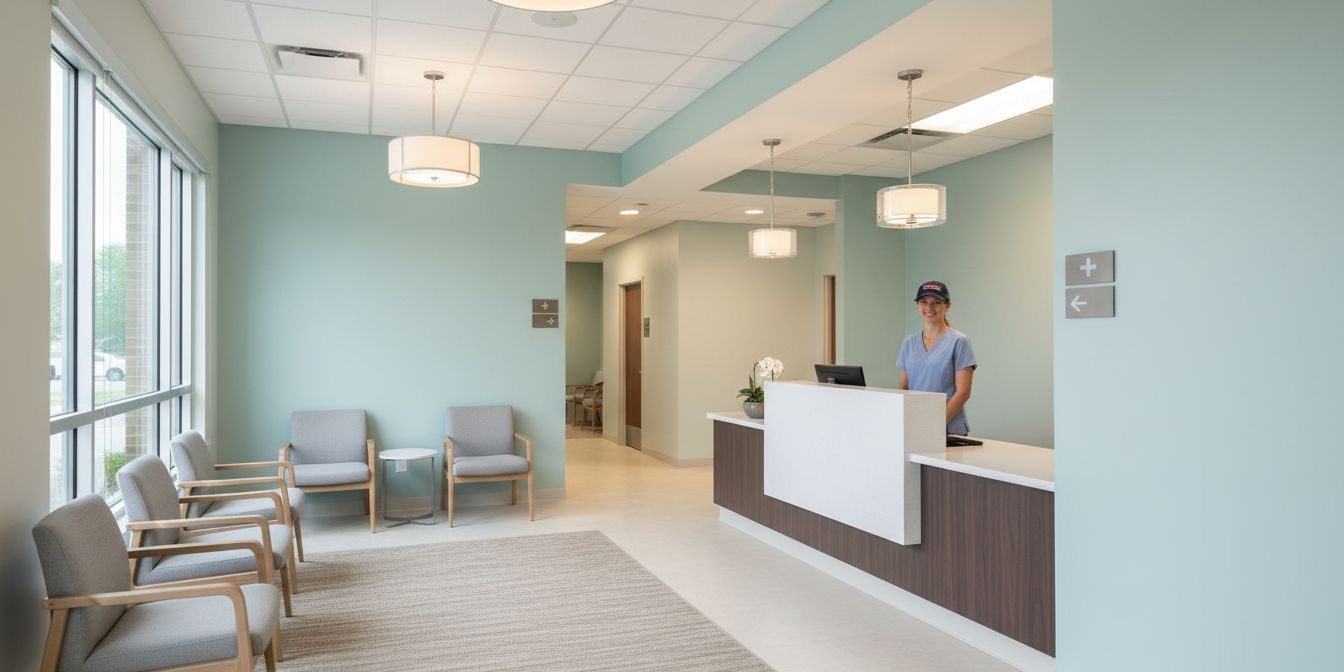
Waiting areas and reception are high-traffic, high-touch zones with patient-facing importance. Color psychology matters here—calming colors reduce anxiety. Scrubbable, durable coatings handle the wear from hundreds of patients and staff passing through daily. Consider antimicrobial treatments for check-in counter areas and high-touch surfaces like door handles.
Bathrooms and hygiene areas demand chemical-resistant, antimicrobial coatings. These spaces see heavy disinfectant use and moisture exposure. Hospital-grade systems withstand this environment far better than standard paint.
Office and administrative areas may use standard low-VOC coatings if not high-traffic or patient-facing. However, many clinics choose consistent, professional finishes throughout for aesthetic coherence and staff morale.
Break rooms and staff areas benefit from low-VOC systems that support staff wellness. Fresh, well-maintained spaces improve staff retention and morale in high-stress healthcare roles.
Step 4: Establish Your Budget and Prioritize
Hospital-grade painting costs more than standard commercial painting, but the investment pays dividends.
Budget expectations:
- Zero-VOC paint systems: 10–15% premium over standard commercial paint
- Antimicrobial coatings: Additional cost for high-touch surfaces, but concentrated in smaller areas (doors, frames, counters)
- Professional prep and containment: HEPA filtration, negative air pressure, dust barriers add cost but prevent contamination
- Off-hours labor: Weekend or evening work costs 25–40% more but allows operational continuity
- Phased scheduling: Extends timeline (more labor days) but allows operations to continue
A typical medical office refresh (3,000–5,000 sq ft) with hospital-grade systems, professional containment, and some off-hours work runs $8,000–$15,000. Scaling depends on your facility size, complexity, and operational constraints.
If budget is tight, prioritize:
- Exam rooms and high-contact clinical areas
- Waiting room and patient-facing areas
- Bathrooms and hygiene spaces
- Office and administrative areas last
The Painting Process: Containment, Safety, and Quality Control
When your contractor begins work, specific protocols protect patient safety and ensure quality results.
Dust containment and negative air pressure during prep and application prevents paint dust and debris from contaminating patient areas. HEPA filtration systems and plastic sheeting isolate the work zone, while negative air units actively remove airborne particles. This approach allows clinics to continue seeing patients in unaffected areas.
Daily cleanup and area sealing ensures work zones are cleaned and sealed each evening before patient arrival. This requires discipline and healthcare-industry experience—a standard contractor won’t maintain the rigor medical facilities demand.
Off-hours and weekend scheduling completes high-VOC work (prep, priming) outside business hours. Topcoats and final finishing can occur during late afternoon or weekends, then cure overnight for morning patient operations.
Air quality verification before patient resumption confirms that off-gassing has ceased and VOC levels are safe. Professional contractors conduct air-quality testing to document this.
Quality inspection verifies paint coverage, finish consistency, and durability before project completion. Hospital-grade work demands higher standards than typical commercial projects.
Working With an Experienced Healthcare Painting Contractor
Not every painting company understands medical office requirements. Choosing the right contractor is as important as choosing the paint system.
Look for documented healthcare experience. Ask contractors for references from local medical offices, clinics, and healthcare facilities they’ve painted. Verify their familiarity with infection-control protocols, regulatory requirements, and hospital-grade paint systems. A contractor with residential or general commercial experience may not understand your specific needs.
Verify licensing and insurance. Medical offices need contractors carrying general liability and workers’ compensation insurance, with certificates naming your facility as additional insured. This protects you from liability exposure.
Confirm knowledge of paint systems and coatings. A qualified healthcare contractor explains the difference between standard, commercial-grade, and hospital-grade systems. They guide you toward zero-VOC, antimicrobial, and scrubbable finishes appropriate for each clinic area. They discuss why certain products matter for infection control.
Assess project management discipline. Healthcare painting requires strict scheduling, daily cleanup, air-quality management, and coordination with your clinical staff. Ask how they manage off-hours work, phased scheduling, and operational continuity.
Review their local reputation. In Orlando, Apopka, and surrounding areas, contractor reputation in the medical community matters. Overtop, a family-owned painting company serving Central Florida for over 21 years, has earned a 5-star Google rating and strong standing among local healthcare facilities. This reputation reflects years of reliable, compliant, high-quality work.
The ROI of Professional Medical Office Painting
Professional medical office painting is an investment with measurable returns.
Patient confidence and perception improve immediately. A fresh, clean, professionally maintained interior signals that your facility prioritizes patient care and safety. This translates directly to patient satisfaction, referrals, and retention.
Regulatory readiness protects your license and reputation. A recent professional paint job demonstrates compliance with Florida healthcare standards and best practices. Inspectors and auditors see evidence of operational excellence.
Staff retention and morale improve in well-maintained environments. Healthcare workers face demanding roles. A bright, clean, professionally painted workspace reduces burnout and supports employee morale—critical for staff stability.
Operational longevity reduces long-term costs. Hospital-grade paint lasts 5–7 years under continuous medical disinfection, compared to 2–3 years for standard paint. This durability reduces your painting frequency and total cost of ownership.
Lease negotiations and facility valuations benefit from professional interiors. If you’re renewing a medical office park lease or preparing your facility for expansion financing, professional paint systems add measurable value.
Planning Your Next Steps
Medical office painting planning begins with honest assessment of your current condition and your operational constraints. Document areas needing attention, define your timeline, and establish your budget.
When you’re ready to discuss your project with contractors, ask about their healthcare experience, their understanding of infection-control protocols, and their approach to hospital-grade paint systems. Request references from local medical offices and verify their local reputation.
For clinics in Orlando, Apopka, Winter Park, Altamonte Springs, and surrounding Central Florida areas, Overtop brings over 21 years of specialized healthcare painting experience. The company understands the regulatory landscape, infection-control requirements, and operational constraints that medical offices face. Overtop’s 5-star Google rating reflects a commitment to quality, reliability, and customer satisfaction—exactly what healthcare facilities deserve.
Your patients notice the details. A fresh, professionally maintained interior becomes part of their care experience. Start planning your medical office painting project today and transform your clinic into the professional, patient-ready space your facility deserves.


