


 407-450-2020
I need to retrieve the article details and internet search data from the previous workflow steps to write this blog post. Let me gather that information now.
Why You Need a Licensed and Insured Painting Contractor in Orlando, Florida
When you’re planning a painting project in Orlando, Florida, the stakes are higher than most homeowners realize. Your choice to hire a licensed and insured painting contractor determines not just the quality of work—it directly affects your liability, your property’s resale value, and your peace of mind for years to come.
Every day, homeowners and business owners in Orlando, Apopka, Winter Park, and surrounding Central Florida cities make one critical mistake: they prioritize low cost over legal protection. The consequences can be devastating—injuries on your property, damaged finishes, unfinished projects, and a landscape of legal headaches that a simple estimate never warned you about.
This guide explains exactly why licensing and insurance matter, what to verify before hiring, and how to spot the red flags that separate legitimate professionals from unlicensed operators.
What “Licensed and Insured” Actually Means for Homeowners
You’ve probably seen the phrase “licensed and insured” on countless contractor websites. But what does it actually protect you from?
A licensed painting contractor holds credentials from the Florida Department of Business and Professional Regulation (DBPR). This means the company has passed inspections, carried workers’ compensation insurance, paid state licensing fees, and agreed to follow Florida’s construction laws and safety codes. Licensing is proof that someone vetted them—not just a casual promise from a business owner.
Insurance coverage comes in two critical forms:
-
General Liability Insurance — covers damage to your property, injuries to the crew, or accidents that occur during the job. If a painter spills paint on your hardwood floor or injures themselves in your home, the contractor’s insurance pays, not yours.
-
Workers’ Compensation Insurance — covers medical expenses and lost wages if a crew member is injured on the job. Without it, you could be held responsible for hospital bills, even if the accident wasn’t your fault.
When a contractor is both licensed and insured, you’re protected on multiple fronts. If something goes wrong, there’s a clear chain of liability and a mechanism to recover damages. Without it, you’re personally liable.
The Real Risk: Unlicensed Painters in Central Florida
Florida’s construction industry has a significant problem with unlicensed contractors. The DBPR actively pursues crackdowns on illegal operators, but the problem persists because homeowners often don’t ask the right questions before hiring.
Here’s what happens when you hire an unlicensed painter:
-
You become liable for injuries. If a crew member is hurt in your home, you could be sued personally. Their medical bills, lost wages, and pain-and-suffering claims all fall on you—or your homeowner’s insurance, which may refuse to cover work done by unlicensed contractors.
-
You have no recourse for poor work. Licensed contractors answer to the DBPR. Complaints can trigger investigations, license suspensions, or loss of credentials. Unlicensed operators? They simply disappear. Your incomplete project and your deposit are gone.
-
You violate HOA and lending rules. Many homeowners associations in Orlando neighborhoods like College Park, Baldwin Park, and Thornton Park explicitly require that painting work be completed by licensed contractors. Banks and lenders often have the same requirement. You could end up unable to sell your home or refinance your mortgage.
-
You lose EPA compliance on lead paint work. If your home was built before 1978, federal law requires lead-safe work practices. Only EPA-certified contractors can legally handle lead-paint scenarios. Unlicensed crews operating without certification put your family at direct health risk.
Why Verification Matters: What to Check Before Hiring
Before you call a painter, here’s your pre-hire checklist:
1. Ask for the DBPR License Number
Every licensed contractor in Florida has a unique DBPR license number. Ask the painter for it and verify it online at www.myfloridalicense.com. Don’t accept vague answers like “we’re in the process of getting licensed” or “the owner is licensed, but I’m not.” That’s a red flag. The person doing work on your home should be individually licensed or working under a licensed company with documented authorization.
2. Request Insurance Certificates
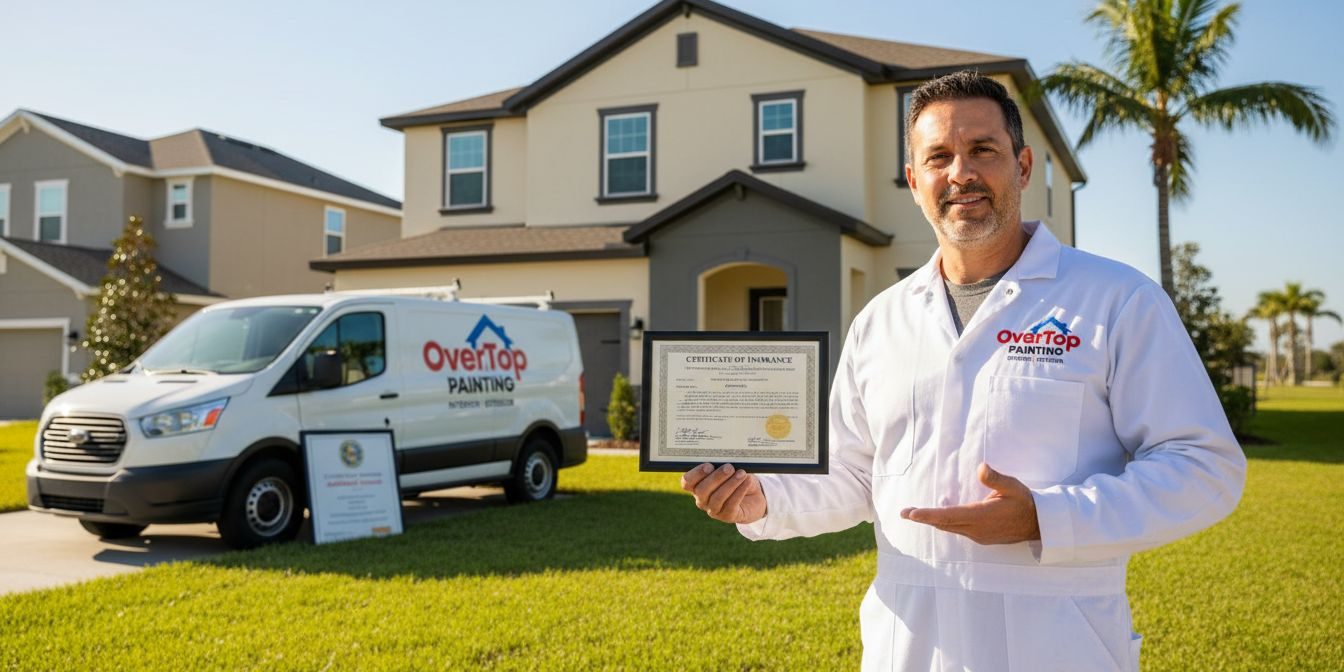
Ask for a Certificate of Insurance showing both general liability and workers’ compensation. It should list your address as an “additional insured” so you’re protected if something goes wrong. Call the insurance company to confirm the policy is active—not expired and not just sitting in a file folder.
3. Verify They’re Bonded
A performance bond guarantees the job will be finished as promised. It’s not required in Florida, but it’s a sign of professional accountability. Legitimate contractors with strong track records often carry bonds voluntarily because it demonstrates confidence in their work.
4. Check Google Reviews and the Better Business Bureau
In Orlando’s competitive painting market, reviews tell a story. A contractor with 5-star ratings and 50+ reviews from local homeowners in Baldwin Park, Conway, or Winter Park has built a reputation worth protecting. One with no reviews or a mix of complaints about unfinished work or billing disputes should be approached with skepticism.
5. Get Everything in Writing
A written estimate should include scope of work, materials, timeline, payment schedule, and warranty details. If the painter resists putting things in writing, walk away. Legitimate contractors like Overtop, a family-owned Orlando painting company with over 21 years of experience and one of the few 5-star rated painting services on Google in the region, provide detailed estimates before a single drop of paint touches your walls.
Common Scenarios Where Licensing and Insurance Save You
Scenario 1: A Crew Member Gets Injured
Your exterior painting project in Dr. Phillips is underway. A crew member falls off scaffolding and breaks their arm. Here’s what happens:
-
If the contractor is insured: Their workers’ comp policy covers the medical bills, lost wages, and rehabilitation. You don’t pay. The crew member files a claim with the contractor’s insurance, not your homeowner’s policy.
-
If the contractor is unlicensed and uninsured: The injured worker could sue you directly. Even if you win the case, legal fees could exceed $10,000. Your homeowner’s insurance may deny the claim because the work was done by an unlicensed contractor. You could be financially liable for tens of thousands of dollars.
Scenario 2: Damage to Your Property
During interior painting in your Edgewood home, a painter spills a full can of exterior-grade paint across your hardwood living room floor. The damage is extensive—the wood warps, and refinishing costs $8,000.
-
If the contractor is insured: Their general liability policy covers the damage. You file a claim, and you’re made whole.
-
If the contractor is uninsured: You’re out $8,000. You might pursue a small claims court case, but recovering money from an unlicensed operator is nearly impossible. Many operate under cash-only business models specifically to avoid accountability.
Scenario 3: The Job Never Gets Finished
You hire a contractor for a full exterior repaint in Lake Nona. You pay a deposit, work starts, and then the painter disappears for weeks. Calls go unanswered. Your home looks half-finished, and the painter won’t return.
-
If the contractor is bonded: The surety bond guarantees the work will be completed. You file a claim, and the bonding company either requires the painter to finish or pays for a replacement contractor to do the job.
-
If the contractor is unlicensed: You have almost no legal recourse. Your deposit is likely gone. You’ll need to hire another contractor at full price to complete the work, effectively paying twice.
How Licensing Protects You Against Florida’s Specific Risks
Central Florida’s climate and construction landscape create unique painting challenges. Licensed contractors must meet specific requirements because of these regional factors:
Hurricane Preparedness and Exterior Standards
Florida’s hurricane season demands exterior paint that can withstand high winds, salt spray, and intense UV exposure. Licensed contractors are trained and held accountable for using appropriate coatings and application methods. If a hurricane damages your home and your insurance investigates, they’ll ask: “Was this painted by a licensed professional using code-compliant materials?” An unlicensed job could actually deny you insurance coverage for weather-related damage.
Lead Paint Compliance (Pre-1978 Homes)
Older homes in neighborhoods like Thornton Park and College Park were often painted with lead-based paint. Federal law requires EPA-certified professionals to handle lead-paint renovation work using specific containment and cleanup protocols. Only licensed, trained contractors can legally take on these projects. Unlicensed crews exposing your family to lead dust create a documented health liability that could haunt future property sales.
HOA and Vendor Requirements
Orlando’s thriving residential communities—Baldwin Park, MetroWest, Bay Hill, and others—often have strict HOA rules. Many explicitly require painting contractors to be licensed and insured before work begins. Hiring an unlicensed painter could violate your deed restrictions, trigger HOA fines, or prevent you from selling your home until the work is redone by a licensed professional.
What to Expect From a Professional, Licensed Painting Contractor
When you hire a contractor who takes licensing and insurance seriously, here’s what the experience should look like:
- A detailed, written estimate that breaks down materials, labor, timeline, and cost.
- Clear communication about insurance before work begins—certificates provided, your address listed as additional insured.
- Licensed crew members who carry identification and can explain their qualifications.
- Transparent pricing with no hidden fees or surprise charges when the job is done.
- Professional cleanup daily, leaving your home or business clean every evening.
- A warranty that stands behind the work for months or years after completion.
- Responsive communication—your calls and emails get answered, and scheduling is reliable.
Companies like Overtop in Apopka serve Orlando, Kissimmee, Winter Park, Altamonte Springs, and the surrounding region with exactly this standard. Over 21 years of operation and a reputation as one of the few 5-star rated painting services on Google in Orlando means the company has made licensing, insurance, and customer satisfaction core to every project.
Red Flags That Signal an Unlicensed or Uninsured Contractor
Watch for these warning signs:
- No written estimate or contract. Legitimate contractors document everything.
- Reluctance to provide license numbers or insurance certificates. If they won’t share proof, they likely don’t have it.
- Pressure to pay cash upfront. Unlicensed operators prefer untraceable payment methods.
- Vague answers about who owns the business or who will do the work. Legitimate operators are transparent about their team structure.
- No physical office or local presence. Companies operating out of their vehicle with no permanent address are higher risk.
- Extremely low bids compared to competitors. In Orlando’s market, if a quote is 30-40% below average, ask yourself: how are they cutting corners?
- No online presence or reviews. A 21-year-old company should have a footprint. Newer companies should have at least a few verified Google reviews.
How to Verify Licensing in Florida: Step-by-Step
- Get the contractor’s DBPR license number from their estimate or website.
- Visit www.myfloridalicense.com.
- Click “License Verification.”
- Enter the license number and search.
- You’ll see the license holder’s name, license type, issue date, and expiration date. The license must be active (not expired or suspended).
- If it’s suspended or expired, the contractor cannot legally operate painting work in Florida.
This takes 60 seconds and protects you completely. There’s no excuse to skip it.
The Long-Term Value of Hiring Licensed and Insured Professionals
Your painting investment isn’t just about aesthetics—it’s about protecting your property and your family. A licensed, insured contractor:
- Increases your resale value. Buyers in Orlando’s competitive market ask questions. “Was this work done by a licensed professional?” becomes a deal-breaker if the answer is no.
- Maintains your insurance eligibility. Using unlicensed contractors can void coverage or trigger rate increases.
- Protects your HOA standing. Many neighborhoods in Winter Park, Altamonte Springs, and Apopka explicitly require licensed work to remain in good standing.
- Gives you legal recourse. If something goes wrong, you have documented proof of who did the work and insurance to recover damages.
- Guarantees compliance. Federal lead-paint rules, EPA standards, and Florida-specific codes are all properly followed, reducing your liability for future issues.
Making Your Decision: The True Cost of Cheap Painting
You might encounter a painter in Orlando or Apopka willing to do your project for 20% less than licensed competitors. Here’s the math:
A typical residential exterior paint job costs $3,000–$7,000. If an unlicensed painter offers $2,400, you save $600 upfront. But if a crew member is injured, your liability exposure could be $50,000+. If damage occurs to your property, you could be out $5,000–$10,000. If the job is never finished, you’re paying twice to complete it.
That $600 savings evaporates instantly when something goes wrong. And in construction work, something usually does.
Take Action: Hire Confidently in Central Florida
Before you hire your next painting contractor in Orlando, Apopka, Winter Park, Kissimmee, or any Central Florida city, commit to this process:
- Get the license number and verify it online.
- Request insurance certificates and confirm they’re active.
- Check Google reviews and the Better Business Bureau.
- Get a written estimate with detailed scope and timeline.
- Ask for references from recent projects in your neighborhood.
A licensed, insured contractor with years of local experience—someone who’s built a reputation one 5-star review at a time—is worth the investment. Your home, your family, and your financial security depend on it.
The painting professionals who’ve earned trust in Orlando’s competitive market understand this completely. They document their credentials because they’re proud of them. They provide insurance certificates without hesitation because they know it’s non-negotiable for homeowners who are thinking clearly.
Don’t settle for less. Your next painting project is an opportunity to protect yourself and your property for years to come.


